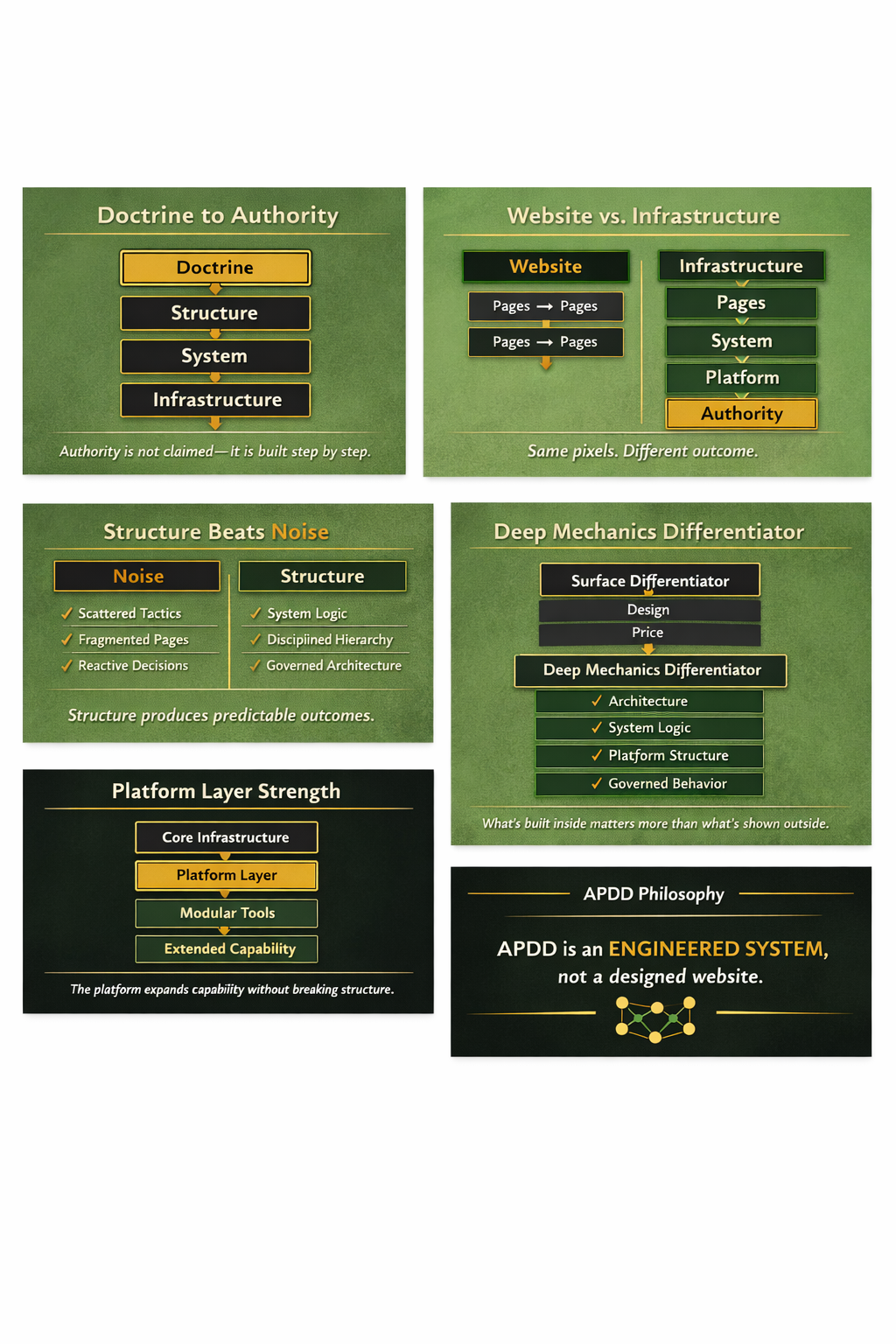
A website presents. Infrastructure performs.
Many people use the word website to describe any business presence on the internet. Technically, that is true. But in practice, there is a major difference between something that simply exists online and something that can operate reliably under pressure, support growth, guide users clearly, and remain stable over time.

A standard website may look polished and still fail where it matters most. It may be slow, difficult to maintain, structurally weak, confusing to navigate, dependent on brittle tools, or unable to scale when attention increases. It may win on appearance and lose on operation.
APDD approaches the problem differently. We do not treat a serious digital presence as a decorative surface. We treat it as infrastructure: something that must perform, remain understandable, reduce risk, support trust, and continue functioning when real-world conditions become less forgiving.
Structure Beats Noise
Many digital systems fail because they are built to attract attention before they are built to sustain function. Noise can create temporary motion, but it cannot create durable authority. APDD begins with engineering logic: stability, clarity, performance, scalability, and then appearance.
That order matters. When structure is correct, confidence becomes natural. When structure is weak, design is forced to compensate for deeper problems it cannot solve.
APDD can build in a way that makes outstanding issues rare, visible, and quickly correctable instead of hidden, compounding, and chaotic. That is part of the core logic of APDD: websites become systems, systems become infrastructure, and infrastructure demands discipline.
Most businesses do not have a website problem
They have a structure problem.
Organizations usually do not fail online because they lacked a homepage. They fail because the underlying structure could not support the demands placed on it. Traffic increases, content grows, teams change, tools age, security expectations tighten, and users become less tolerant of confusion. A fragile website becomes expensive long before it becomes obviously broken.
Confusing navigation, inconsistent messaging, weak trust signals, disconnected service categories, bloated tooling, and poor maintainability are not cosmetic issues. They are infrastructure issues.
Infrastructure presence means making better decisions at the beginning. It means planning for search visibility, usability, ownership, maintainability, performance, and operational clarity before the system becomes crowded with patches, plugins, exceptions, and hidden dependencies.
The structural difference
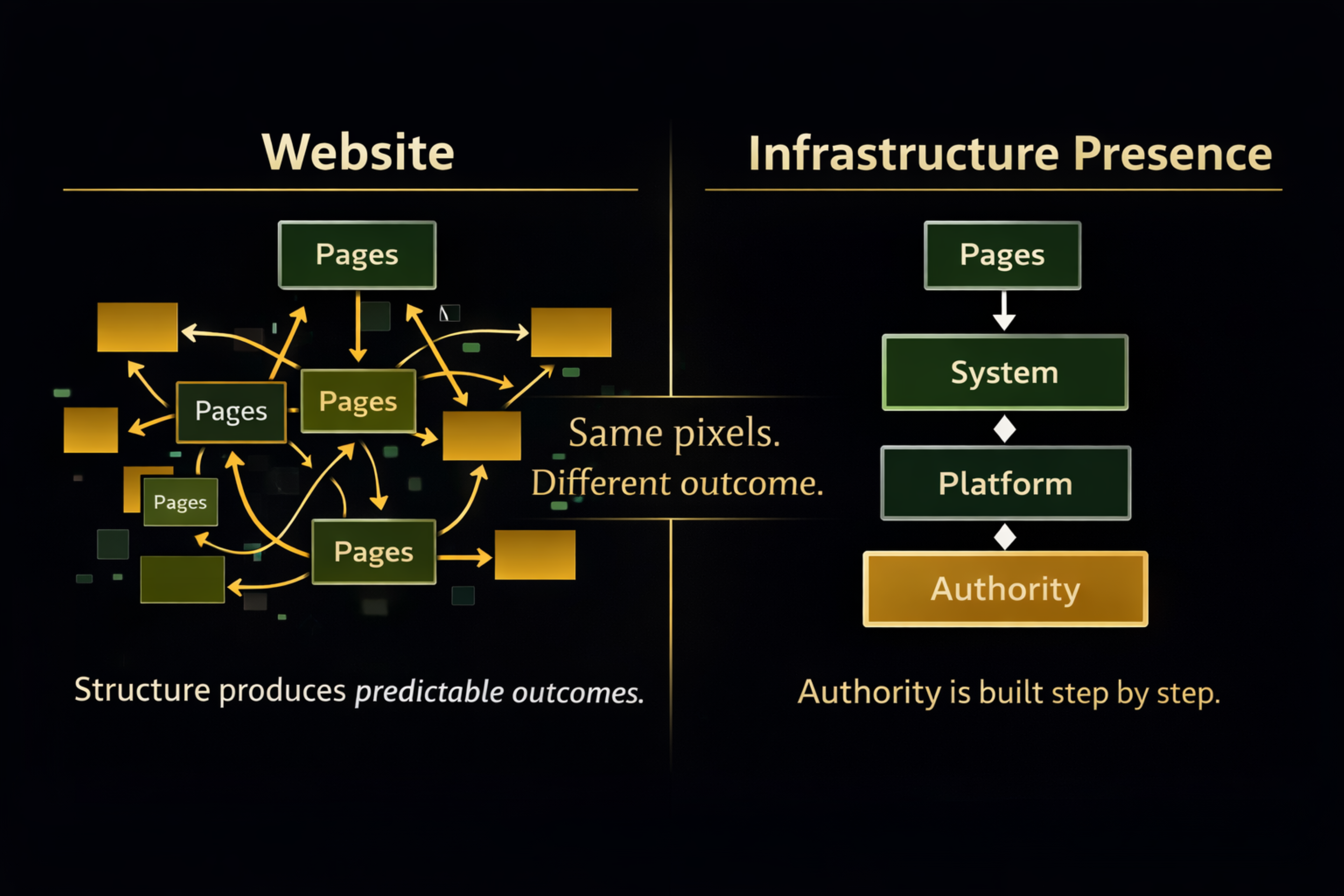
Website
- Built for appearance first
- Often template-dependent
- Security treated as an add-on
- SEO approached late or inconsistently
- Navigation designed for appearance more than clarity
- Grows messy as content expands
- Maintenance becomes reactive
- Ownership and logic are often unclear
Infrastructure Presence
- Built for structure first
- Designed to operate under pressure
- Security considered by design
- SEO embedded into the architecture
- Navigation built for comprehension and action
- Content expansion stays manageable
- Maintenance remains predictable
- Ownership, scope, and behavior are defined
Infrastructure is built to operate
A serious digital system is not judged only by launch-day appearance. It is judged by how it behaves after launch: how fast it loads, how clearly it communicates, how easily users can move through it, how difficult it is to break, how expensive it is to maintain, and how well it handles future changes without collapsing into confusion.
APDD infrastructure builds are designed around operation. That means the site is not merely a visual presentation layer. It becomes a digital operating surface that can support visibility, trust, structured communication, and growth without requiring constant firefighting.
In practice, this means cleaner markup, simpler architecture, stronger internal consistency, more deliberate call-to-action logic, clearer page hierarchy, better metadata structure, fewer unnecessary moving parts, and a stronger relationship between design and function.
Authority is earned structurally
Authority is not created by louder claims, trend-driven design, or exaggerated messaging. It emerges when a digital system runs reliably, explains itself clearly, separates categories correctly, and continues to perform as complexity increases.
In APDD language, this is Infrastructure Authority: trust earned through disciplined execution, structural clarity, and governed digital presence.
Discipline produces authority. Systems that behave clearly are easier to trust, easier to maintain, and easier to grow.
Trust is structural
Trust is often discussed as a branding issue, but in digital systems it is also structural. Users trust what behaves clearly. They trust pages that load quickly, interfaces that do not fight them, language that makes sense, and pathways that feel intentional. Search engines also reward many of these same qualities because structural clarity tends to correlate with usefulness.
APDD does not rely on manipulation to simulate professionalism. We believe trust should emerge from disciplined execution. The system should feel stable because it is stable. The message should feel coherent because the architecture supports it. The site should feel credible because the underlying logic is not chaotic.
Clear systems create trust. Trusted systems convert better.
SEO is not a plugin. It is architecture.
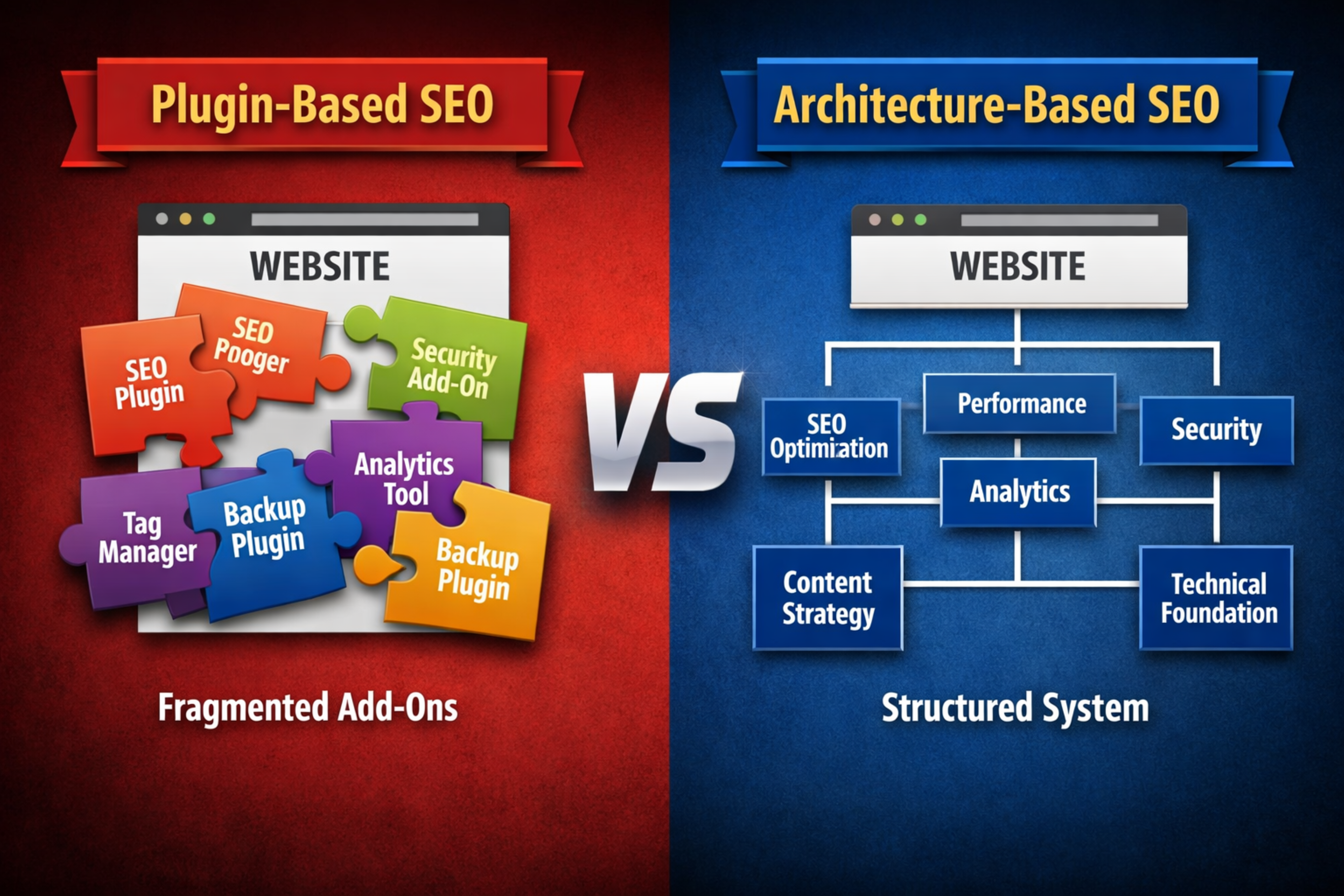
One of the biggest misconceptions in modern web work is that search performance can be attached to a weak site after the fact. In reality, strong SEO is deeply connected to structure. Search systems do not simply read words; they read hierarchy, clarity, metadata, internal relationships, page intent, and consistency.
Infrastructure presence treats SEO as part of the build itself. That means page titles, descriptions, headings, content hierarchy, internal linking, load behavior, crawl clarity, and page purpose are considered early instead of being patched in after confusion has already been built.
APDD builds pages that support search understanding by design. That does not guarantee instant rankings, but it does create a stronger foundation for visibility because the system is easier to interpret, easier to trust, and easier to expand without losing coherence.
Security and maintainability begin early
Weak systems often postpone security thinking until after something goes wrong. APDD takes the opposite approach. We reduce attack surface early, avoid unnecessary complexity, and design for maintainability from the beginning. Cleaner structure is not just easier to manage — it is usually safer.
Infrastructure presence also means respecting the future operator. The system should not become a burden simply because someone wants to update content, adjust messaging, refine layout, or expand the site later. Hardening a site is not only about preventing misuse. It is also about making sure legitimate maintenance stays manageable.
Who this is for
APDD is for people who value clarity, discipline, durability, and operational sanity. It is for organizations that are tired of fragile builds, bloated tools, rented logic, and digital surfaces that look polished but fail under ordinary pressure.
If you want something that merely looks modern for a moment, many providers can deliver that. If you want a digital presence that behaves like infrastructure — fast, readable, stable, secure-minded, search-aware, and easier to govern — that is where APDD fits.
If it requires deception to function, lease, or sell, APDD does not build it.
Explore the System
Infrastructure presence is only one part of a larger system. To understand how structure, platform capability, governance, and execution work together, explore the core components below.
Arsenal Armory
Explore the platform layer that expands capability without breaking structure.
Explore PlatformGovernance
See how systems are kept stable, secure, and structurally sound over time.
View GovernanceA page can be published. Infrastructure must be engineered.
A website can be a surface. Infrastructure presence is a system. APDD builds for the second category. We design digital environments meant to communicate clearly, hold under pressure, reduce avoidable risk, and remain useful as the organization behind them grows.
Same pixels. Different outcome. That difference is structure.